

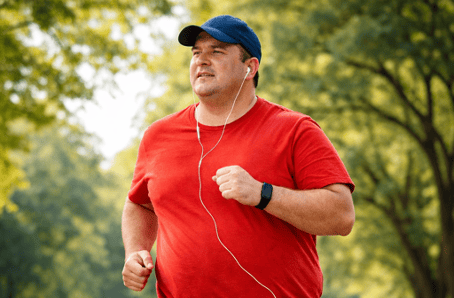
Exercise remains a core element of any weight-loss strategy. At the same time, there is a growing understanding that its greatest benefits are often not visible on the scales, but in metabolic and physical adaptation.
The focus is shifting away from individual workouts…
… toward overall daily activity.
A 40-minute jog in the morning, then proudly off to the office – followed by eight hours of sitting. Many people consider this a success, even though their step counter may still show less total movement than on a day filled with small errands, stairs, and “just” a walk.
Everyday exercise, short walks, or simply spending less time sitting often contribute more to the overall balance than isolated intense sessions. But exercise not only changes daily activity—it also changes how the body responds to training.
Strength training changes the body – even without weight loss.
Fat mass can decrease, muscle mass can increase.
Dwayne Johnson weighed around 120 kilograms in his action roles – your office-working neighbor at the same weight would likely present a very different physique and fitness level.
The number on the scale may stay stable while function, posture, and metabolic markers improve. Progress, therefore, isn’t defined by weight alone.
When not only the how much but also the how is decisive, the focus automatically shifts to training intensity.
More intensity is not automatically better.
Current discussions emphasize sustainability over extreme programs.
A workout can feel great—until the next day when muscle soreness sets in and suddenly every staircase is avoided. If you end up asking your partner to take out the trash instead, that session may have been harder than what makes sense long term.
Routines that can be permanently integrated into everyday life are more effective in the long term than short bursts of extreme effort.
The old question used to be: How hard was the workout?
Today, it’s more like: How active was the day overall?
Dog owners, by the way, meet physical activity recommendations significantly more often than people without dogs. On gray, rainy days they still go outside — not because they’re more motivated, but because daily life demands it.
So — what ideas do you have?