
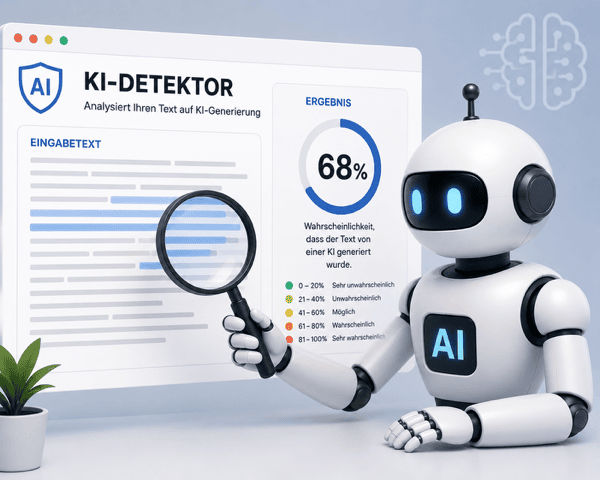
What do we make of a minister having their speech written by an AI? This question was the subject of heated debate only recently. However, top politicians don’t write their own speeches anyway. So does it really make a significant difference whether a human speechwriter or ChatGPT wielded the pen or tapped away at the keyboard?
Almost at the same time, the literary world was grappling with a similar question: the horror novel Shy Girl came under suspicion of having been partly created with the help of artificial intelligence. Readers analysed passages of text, discussed ‘typical AI patterns’ and employed AI detectors. Ultimately, the publisher withdrew the book.
Similar questions underlie both cases. Is it even possible to reliably determine whether a text was produced by AI? And, more fundamentally: is it equally important for every text to know who or what wrote it?
As for the first question, various AI detectors at least promise an answer. But this is precisely where the problem begins. Now a ‘black box’ – the AI detector – is supposed to identify the traces left in a text by another ‘black box’ such as ChatGPT or Claude.
A digital lottery of opinions rather than definitive proof
AI detectors that promise to identify machine-generated texts are already being used by schools, universities, publishers and businesses. In practice, however, their judgements are often alarmingly contradictory. If you run the same text through several detectors, it is not uncommon to receive completely different assessments.
We have tested various popular detectors on different types of text. Of course, this is not a scientific study. However, this small practical test illustrates very clearly just how cautiously one should treat the results.
| ZeroGPT: | AI Detector: | Pangram: | |
| Song lyrics, 100 % ChatGPT-generated |
100 % Human | 82 % Human | 100 % Human |
| Short factual text on tides, 100 % ChatGPT-generated |
55 % AI
56 % AI (after applying Humanizer) |
95 % Human
75 % Human (after applying Humanizer) |
100 % Human
100 % AI (after applying Humanizer) |
| Medical Newsletter, 100 % written by the author without any AI assistance | 93 % AI | 98 % Human | 100 % Human |
These results clearly illustrate why reputable articles that refer to the findings of AI detectors always phrase their conclusions with caution. A medical text written entirely by a human was classified by one tool as having a 93 per cent probability of being AI-generated. At the same time, song lyrics created entirely by ChatGPT were deemed predominantly or entirely human-written by all three detectors tested.
It becomes completely absurd when someone tries to conceal the use of AI by using AI itself: so-called ‘humanisers’ are designed to rephrase AI texts so that they appear more human and are no longer detected by the tools. In our experiment, however, the result was by no means more reliable. In some cases, the detectors even classified the edited text as AI-generated more frequently.
At this point, at the very latest, the question arises as to whether the effort involved isn’t greater than simply editing the text carefully oneself from the outset.
Not every use of AI should be judged in the same way
But should every use of AI be viewed as fundamentally negative?
In a novel, readers expect not only a plot but also an individual voice, creativity and the author’s personal choices. The person behind the novel is, in a sense, part of the product.
Consequently, reactions are particularly sensitive whenever there is a suspicion that AI might be behind large sections of a literary text.
In the case of political speeches, the situation is more complicated. It is nothing new that leading politicians often do not write their own speeches. Nevertheless, a speech should convey the speaker’s stance, position and personality. The crucial question is therefore not so much who formulated each individual sentence. What is more important is whether the speaker stands by the content and takes responsibility for what is said. And when it comes to commemorative speeches, most people would probably find the words of an AI out of place.
Schools and universities face a different problem. If a written assignment is specifically intended to assess a student’s independent ability to research, structure and formulate ideas, AI support alters the assessment outcome. This gives rise to far-reaching problems.
With many non-fiction texts, however, the focus lies elsewhere. A medical background article, a press release or a user manual should, above all, be factually correct, comprehensible and precise.
Here, AI can certainly be a helpful tool: in structuring information, in translations, summaries, suggested headings or formal checks. Many writers are likely to have been using such tools as aids for some time now.
The crucial factor is who takes responsibility
However, this is precisely where problems arise if AI-generated results are actually adopted without being checked. The potential for AI to generate errors or ‘hallucinations’ and present them with the utmost conviction is almost limitless.
At the end of the day, it comes down to professional oversight. What matters is who takes responsibility for the result. There is no doubt that AI can support research, structuring and text editing. However, it cannot replace specialist knowledge, experience, critical thinking and careful quality control.
And for those who are curious: for this article, the following applies
ZeroGTP: 100% written by a human
AI Detector: 90% confident that it’s original
Pangram: 100% Human Written