

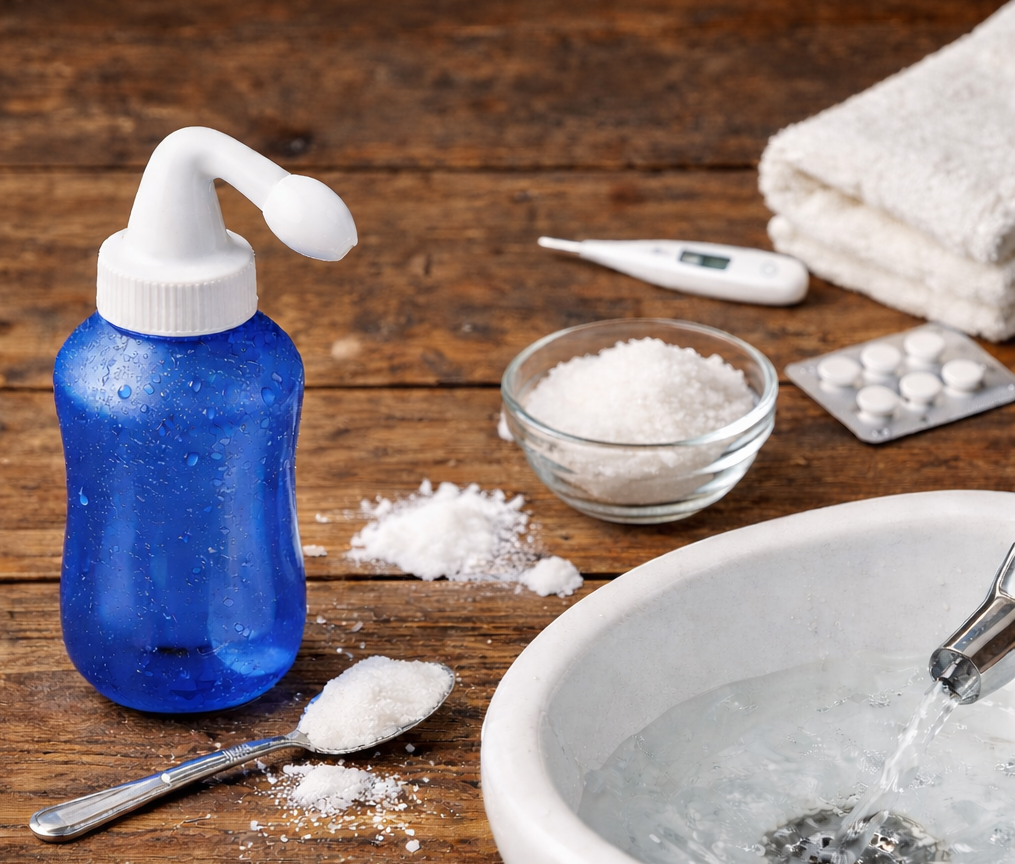
Nasal rinses don’t look like much – but they’re very effective. Reviews also show quite clearly that regular saline irrigation can noticeably reduce symptom burden in chronic rhinosinusitis. In studies, improvements in symptom scores are often in the range of about 20–30 %, accompanied by measurably better quality of life and less mucus congestion. Not a gamechanger overnight, but a measure with a solid effect.
What makes the difference in practice
For this to actually work, the way you do it matters. If your nose is blocked, it makes sense to use a decongestant nasal spray or drops before doing the rinse. For the irrigation, use about 150–250 ml of isotonic saline solution per nostril. The simplest option is pre-portioned nasal rinse salts from a pharmacy or drugstore; you can also get suitable nasal douches or squeeze bottles there. Alternatively, you can mix the solution yourself (about 9 g of salt per 1 liter of water). The water is important: ideally sterile or boiled and then cooled to lukewarm. Lean your head slightly forward over the sink, keep your mouth open, and continue breathing calmly so the nasal secretions can drain properly. Forceful nose blowing is counterproductive because it stresses the mucosa and can push fluid into the sinuses or the middle ear. So it’s better to blow your nose gently, one nostril at a time.
Unspectacular, but effective
The whole procedure isn’t particularly elegant, but it works. Nasal irrigation can be used as often as needed. Symptoms usually improve noticeably after just a few days. Sea salt nasal sprays do not replace irrigation because they simply lack the necessary volume.
Hygiene also determines how useful it is: prepare the solution fresh, clean the irrigation device regularly, and let it dry thoroughly. When used correctly, nasal irrigation is a simple, inexpensive addition to symptomatic therapy – and a good example of how a seemingly unspectacular home remedy can turn out to be surprisingly evidence-based on closer inspection.
By the way: This text is part of our series “Naturally effective?”. In it, we take a close look at home remedies and similar approaches – focusing on what makes physiological sense and has at least a bit of scientific backing.