
New Year’s Eve, sparkling wine and foreign languages
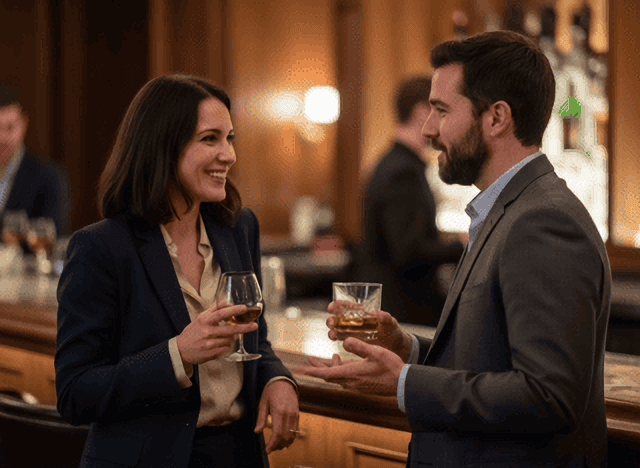
Were you hosting international guests at the turn of the year? If so, you may have noticed how many people’s school English suddenly improves after the first or second glass of sparkling wine. People who would normally internally correct every English sentence several times suddenly speak fluently, confidently and audibly more relaxed.
What sounds like a party anecdote is actually a well-documented phenomenon – and in 2025, the topic even caught the attention of the Ig Nobel Prize Committee: The Ig Nobel Prize, which honours research that ‘first makes people laugh and then makes them think,’ last year recognised a study on precisely this effect, interestingly in the ‘Peace’ category . The Dutch study shows that acute alcohol consumption can, under certain conditions, improve the ability to speak a foreign language. Not just a feeling, not anecdotal, but measurable.
Uninhibited by alcohol
This is explicitly not about more vocabulary or better grammar. The study, published in the Journal of Psychopharmacology in 2018, examined speech inhibition. In other words, that inner control mechanism that permanently slows down many foreign language learners because they check every sentence for mistakes in advance.
After moderate alcohol consumption, Dutch test subjects spoke – from the outside perspective – more fluently and comprehensibly in English in an experiment, without considering themselves to be better. It was not about conceit, but about effect.
The reason: alcohol lowers inhibitions, dampens perfectionism and suppresses the fear of making mistakes. Conversation gains space – and the obligatory ‘Sorry for my bad English’ that some people use simply disappears.
However, be careful: what improves foreign language use does not apply to the native language. As another Dutch study shows, pronunciation deteriorates measurably with increasing blood alcohol content. Native language expression is usually not influenced by linguistic uncertainties.
So if you happen to meet someone whose English clearly improves after a few drinks, it’s not a New Year’s miracle or any other kind of miracle. It’s evidence-based.
The 2025 IG Nobel Prize winners
Offrede TF et al. The Impact of Alcohol on L1 versus L2. Lang Speech. 2021