

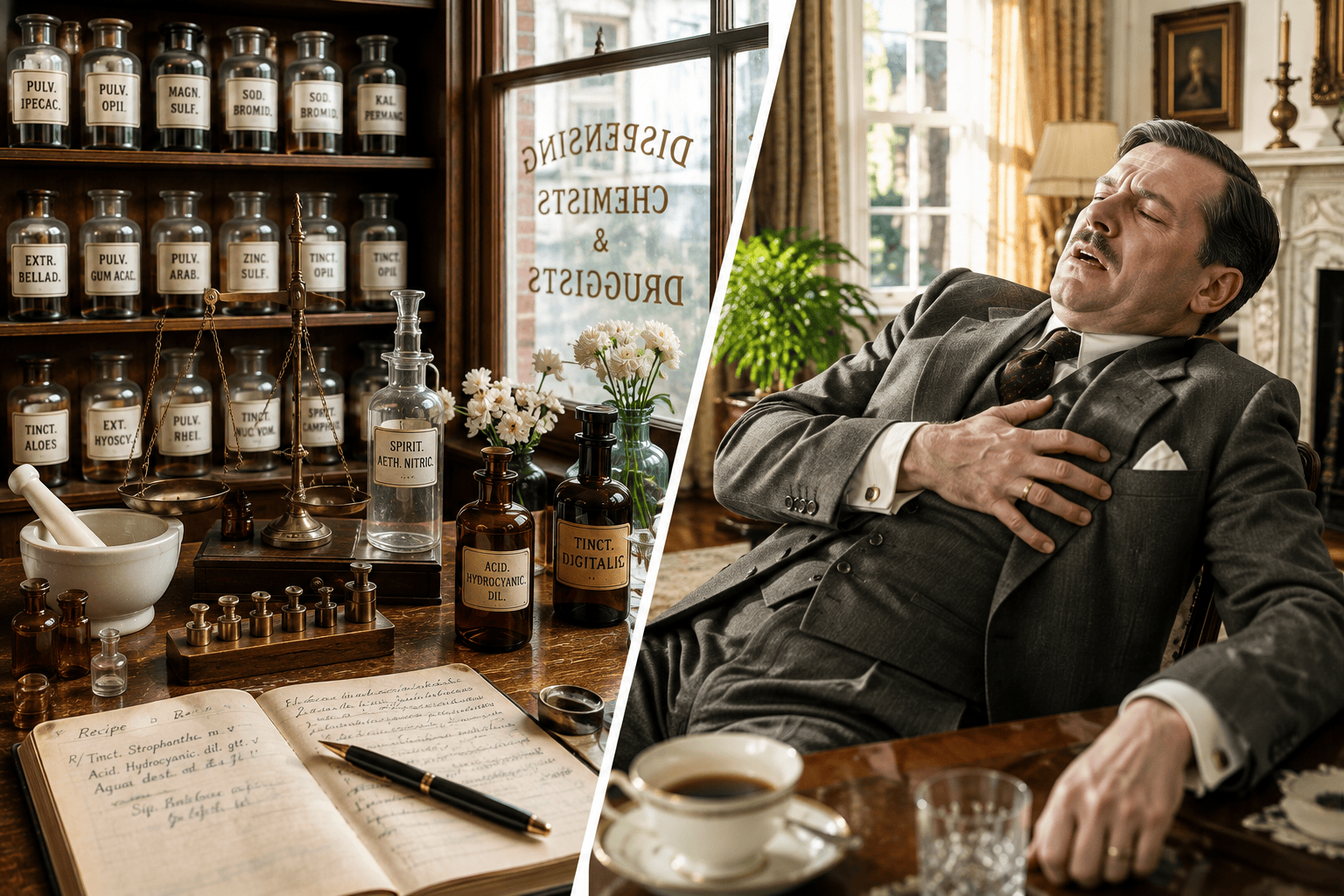
Agatha Christie’s poison murders are fascinating – because even today they seem frighteningly plausible. One key reason lies in her training. During the First World War, she initially worked as a nurse, then in a hospital pharmacy – and did so again during the Second World War. There she prepared medicines, weighed out active ingredients and learnt first-hand just how fine the line between treatment and poisoning can be.
The British chemist Kathryn Harkup has examined this background in greater detail. She shows that Christie did not usually invent her poisons, but instead drew on real medicinal substances and incorporated their mechanisms of action into her plots with astonishing accuracy.
From the medicine cabinet to the crime novel
One example is provided by the Miss Marple story ‘The Case of the Caretaker’. The murder weapon is strophanthin, a cardiac glycoside originally isolated from African arrow poisons. In therapeutic doses, it increases the heart’s contractile force; however, a high intravenous dose can trigger severe arrhythmias, even leading to cardiac arrest. Because strophanthin was poorly absorbed when taken orally, it usually had to be administered by injection – a detail Christie knew from her time working in a pharmacy and which her villain deliberately exploits.
She incorporates a similar trick in *The Chocolate Box*: there, the female culprit hides Trinitrin – that is, nitroglycerine, a heart medication – in chocolates. However, Christie’s plan does not quite work out. According to Harkup’s calculations, the described dose alone would hardly have been lethal. Alcohol might have intensified the blood-pressure-lowering effect – though Christie leaves it open as to whether the victim actually drank any.
But Agatha Christie also takes certain liberties
Not every detail stands up to modern knowledge. In *Death in the Clouds*, Christie uses the venom of the boomslang snake, but depicts the typical bleeding symptoms as unrealistically inconspicuous. The rapid identification of the rare poison also seems implausible from today’s perspective. This does not detract from the suspense – one would have to be very well-informed indeed to prove that Christie made a mistake at all.
Harkup K. The Science of Murder: Agatha Christie’s Deadly Poisons. Lecture; available at: https://www.youtube.com/watch?v=miVg3eiW_Rc