

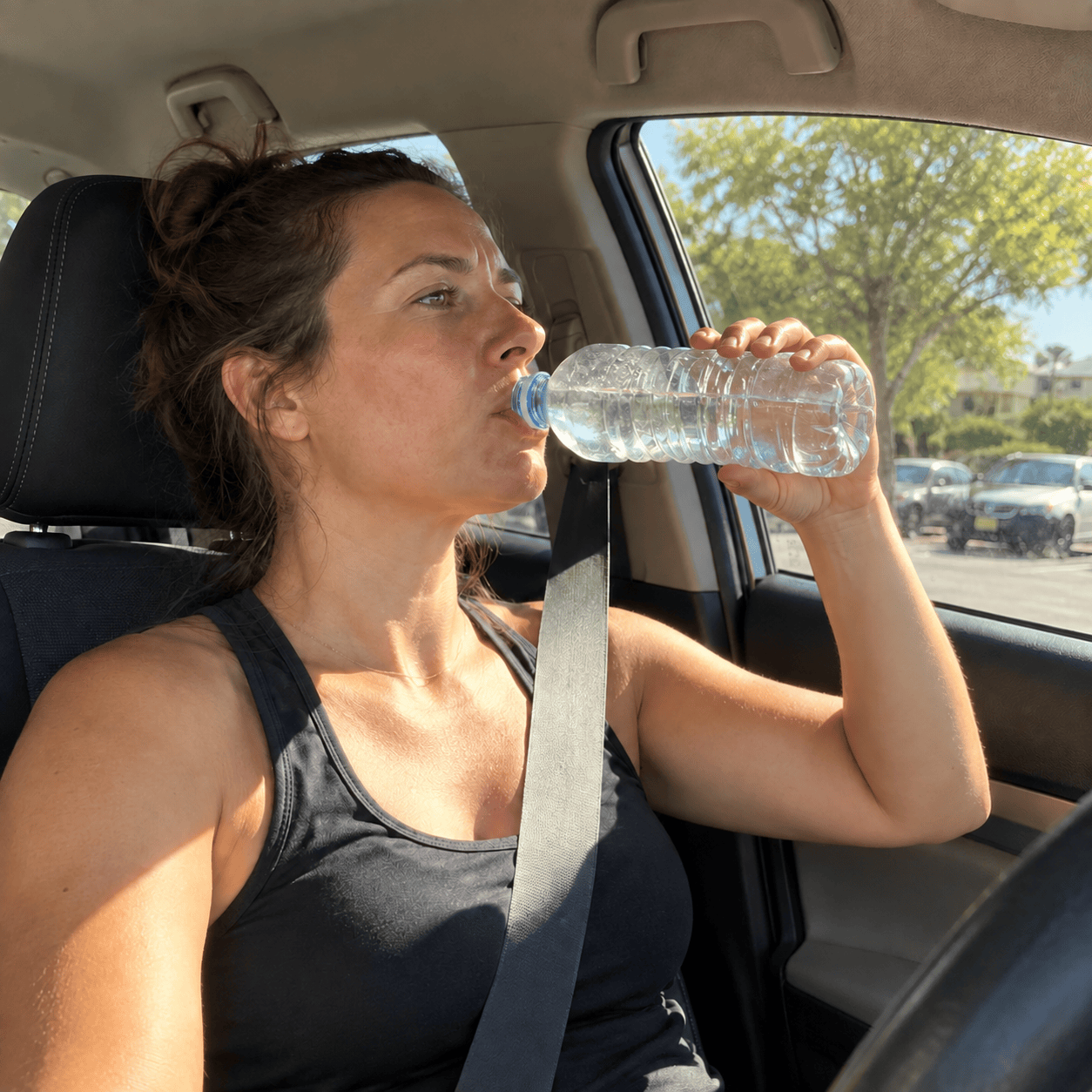
Yesterday, you left the water bottle in the car. It was still quite cool this morning, but now the sun is beating down on the car. You’re still thirsty, though. So: should you unscrew the cap and drink – or is it better to get a new bottle?
Researchers at the University of Nebraska have investigated how typical everyday conditions affect water in single-use polyethylene terephthalate (PET) bottles. To do this, they tested eight popular US brands and subjected the bottles to, amongst other things, high temperatures, movement and repeated temperature changes.¹
When heat meets movement
When heat and movement occur together, the effect is greatest. When shaken at a temperature of 60 °C, the concentration of nanoplastic particles in the water rose to more than nine times the initial level. The amount of microplastic particles also increased. However, it is not just heat that has an impact – in general, repeated temperature fluctuations over a period of 15 days led to an increased release of nanoplastics.
The plastic particles apparently did not originate solely from the PET of the bottle itself. The researchers also found evidence of other plastics, which may have come from the cap, for example.
Better to go thirsty than to drink?
Does this mean that, as a general rule, you should always pour away water from a PET bottle that has been left in a car for a long time? It’s not quite that clear-cut. Micro- and nanoplastics can now be detected in many foodstuffs and also in the human body. However, it is not yet sufficiently clear at what quantities they actually pose a health risk.
Nevertheless, the advice is: store single-use PET bottles in a cool place and protect them from direct sunlight. A car is not a particularly good place for this – neither on hot summer’s days nor for extended periods when temperatures fluctuate. If you’ve left a bottle in the car once, you don’t automatically have to throw it in the bin. However, you might want to reconsider keeping a permanent supply of water stored in the car.